
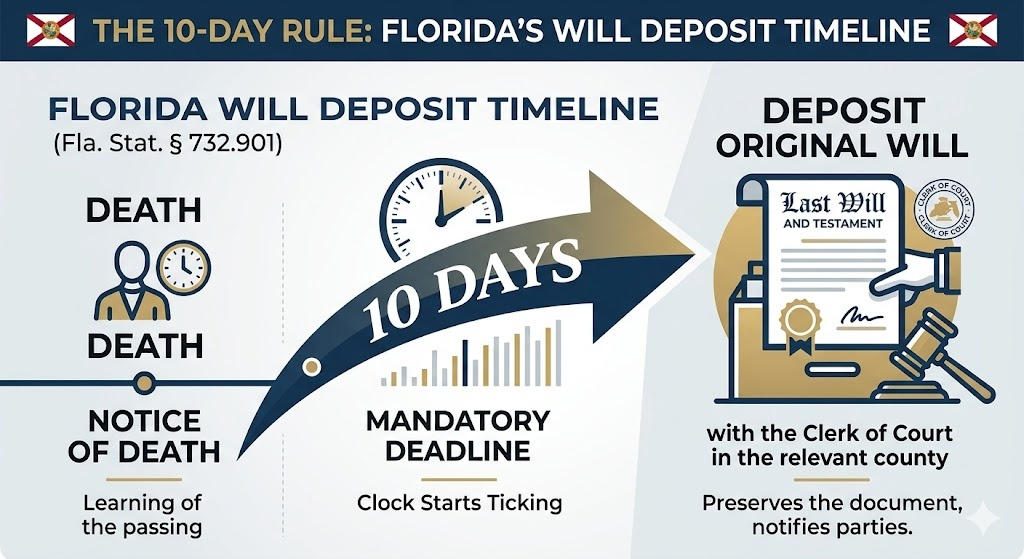
Many families believe that they only need to deal with a Last Will and Testament when they are officially ready to “start probate.” However, in the state of Florida, the law is much more proactive—and the clock starts ticking the moment you learn of a loved one’s passing.
The Legal Mandate
UnderFlorida Statute § 732.901, the custodian of a Will is required to file the original document with the Clerk of Court within 10 daysof receiving notice that the testator has passed away.
Even if you aren’t ready to open a full probate estate, this “Will Deposit” is a critical legal safeguard.
Why the Rush? Understanding the Safeguards
Depositing the Will isn’t just about paperwork; it’s about protection.
- Fraud Prevention: By filing the Will immediately, you “lock” that version as the official document in the public record. This prevents disgruntled heirs from trying to “discover” an older, more favorable version later or destroying the current one to force an intestate distribution.
- Transparency for Stakeholders: A filed Will serves as a formal notice. It allows “interested persons”—including creditors, estranged family members, or secondary beneficiaries—to know their rights exist and understand the decedent’s true final wishes.
- Custodian Liability: This is the big one. Under § 732.901(2), if a custodian refuses to turn over the document, any interested party can petition the court to compel its production. If a judge finds there was no “just or reasonable cause” for the delay, the custodian can be held personally liable for the petitioner’s costs, damages, and attorney’s fees.
How to Deposit a Will (The “Will Only” Filing)
If you aren’t opening a formal probate case yet, the process is straightforward and is often referred to as a “Will Deposit.”
| Step | Requirement |
| Venue | File with the Clerk of the Circuit Court in the county where the decedent lived (their primary domicile). |
| The Document | You must bring the original physical Will. Florida does not allow “e-filing” for initial Will deposits; the Clerk must physically hold the paper original for authentication. |
| Identification | You will typically need to provide the decedent’s date of death or the last four digits of their Social Security Number. |
| The Cost | Most Florida counties charge a nominal “indexing fee” (usually between $1 and $10) to log the document without opening a full probate case. |
Frequently Asked Questions
Q: Does depositing the Will mean I have officially started probate?
A: No. A “Will Deposit” simply places the document in the safe-keeping of the Clerk of Court. It does not open an estate, appoint a Personal Representative, or begin the distribution of assets.
Q: What if I only have a copy and cannot find the original Will?
A: Florida law ($Fla. Stat. \S 733.207$) has specific procedures for “Lost or Destroyed Wills.” However, because there is a legal presumption that a missing original was intentionally revoked, you should consult an attorney immediately to discuss how to establish the terms of a lost Will through witness testimony.
Q: Can I mail the Will to the Clerk instead of going in person?
A: Yes, most Clerks accept original Wills via certified mail. However, given the 10-day deadline and the importance of the document, many people prefer to hand-deliver it to ensure they receive a receipt of deposit.
Q: I missed the 10-day window. Am I in trouble?
A: The 10-day rule is a statutory mandate, but the penalties (like attorney’s fees) usually only trigger if someone has to sue you to get the Will. If you have missed the deadline, the best course of action is to file it as soon as possible to minimize your potential liability.
Q: Is a Death Certificate required to file the Will?
A: While the statute technically only requires the “date of death” or the last four digits of the SSN, many Clerks’ offices request a copy of the Death Certificate to verify the information. It does not necessarily have to be a “certified” long-form copy for a simple deposit.
The Bottom Line
Holding onto a Will in a desk drawer—even with the best of intentions—can expose you to significant legal and financial risk. If you are in possession of a loved one’s Will, fulfill your duty to the court and the beneficiaries by depositing it timely. If you have further questions, please reach out to our dedicated team of professionals.
This blog post is for informational purposes only and does not constitute legal advice. If you have questions regarding a specific estate or the probate process, contact our office for a consultation.